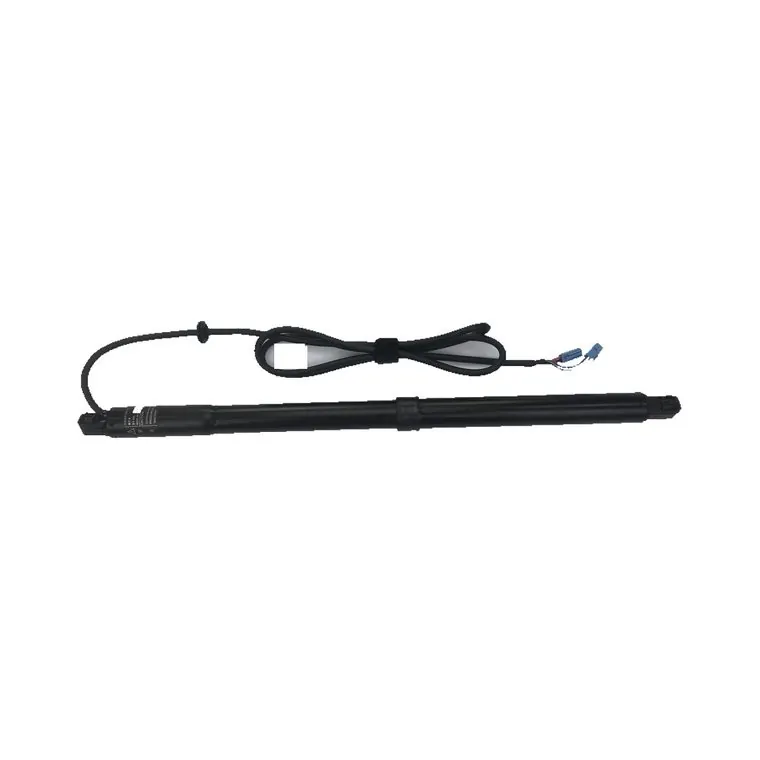
It is the first question a serious buyer asks, and almost nobody selling these kits answers it directly: if the battery goes flat, or the motor fails, can you still open the tailgate?
It is a fair worry. An electric tailgate adds a motor, a control module and a latch actuator to something that used to be purely mechanical. If any of those fail, does the car end up with a boot you cannot open?
This page answers the power tailgate manual release question as far as it can be answered honestly — and where the answer depends on the vehicle, it says so instead of inventing a rule.
Why the question matters more than it looks
A tailgate that will not open is not a small inconvenience. It is where the spare wheel often lives on an SUV, and how you load luggage, tools and stock. On a commercial vehicle it can stop the day's work.
Most of the risk comes from misunderstanding what "electric" changes. On a well-built system it usually changes two things: how the gate is driven upward, and how the latch is released. It does not remove the mechanical structure of the hinge or the strut mounts.
Behaviour in a power failure depends on three situations worth checking one at a time.
Three situations, three different answers
1. The vehicle battery goes flat
This is the common case. The 12V battery is dead, so nothing electrical works.
On most aftermarket power tailgate kits, the gate itself is not what traps you. The hinge still moves, and the latch still has some mechanical release path. What varies is how you reach it: a cable, a disengageable clutch, or — on some designs — only by restoring power through a jump pack or external 12V source.
That last case is not a defect — plenty of factory power tailgates behave the same way — but it is something you should know before you buy, not after.
2. The aftermarket system fails but the car runs
Here the car starts and the lights work, but the tailgate motor or control module has failed.
The question becomes whether the drive can be disengaged. A strut that is electrically driven but mechanically jammed is harder to move by hand than a plain gas strut, because you are pushing against a motor and a gearbox. Whether the design lets you disengage that drive, and how, is a property of the specific kit.
This is also why "the motor died" should not automatically mean "buy a whole new kit". On a system built from separate parts, a failed strut can often be replaced on its own — whether that is possible on yours depends on how the kit is assembled and whether spares are available.
3. After a collision
A different category entirely. If the tailgate is deformed, do not force it. Any release mechanism assumes the gate and body are still in roughly the shape they were designed for. Structural damage is a body-shop problem, not a kit problem.
Why "we have manual release" is not a useful answer on its own
Sellers often answer with a single reassuring sentence. That sentence is not informative: there is more than one way to provide a manual release, and they behave differently.
- A pull cable — releases the latch when pulled. Works with no power at all, but the cable has to be routed somewhere reachable, and it can seize if never used.
- An electromagnetic clutch — a coupling in the drive that can be disengaged so the gate moves freely by hand. Cleaner in daily use, but it depends on the clutch being reachable and on somebody knowing it exists.
- No manual release at all — the system relies on restoring power (jump start, external 12V) to operate. This exists in both aftermarket and factory systems.
None of these is automatically better. A cable is useless if it is buried behind a trim panel. A clutch is useless if the owner has never been told where it is. What matters is that the answer is specific and documented for your vehicle.
What we do, and what we will not claim
We build and supply intelligent electric power tailgate kits: dual-motor struts, a dedicated control module, a plug-and-play harness, dual-direction anti-pinch and a soft-close latch. Kits are configured to a vehicle program rather than sold as a universal part.
On the manual release question specifically, here is our position:
The release method is confirmed in writing on the quotation, for the specific vehicle and kit configuration, before you order.
We will not publish one sentence here claiming a single mechanism across every model we cover, because that sentence would be wrong for some of them. The strut design, latch type and harness layout differ between vehicle programs, and the release path follows from those.
If you are comparing suppliers, treat this as a test rather than a formality. A supplier who can tell you, for your exact model, how the gate opens with no power — and can show it — is telling you something about how the rest of the kit was engineered. A supplier who answers with a generic "yes, it has manual release" has told you nothing.
Four questions worth asking any supplier, including us:
- With the 12V battery disconnected, what is the exact procedure to open the tailgate on this model?
- Where is the release point physically located, and is it reachable with the trim fitted?
- If a strut motor fails, can that strut be replaced on its own, and what does a replacement involve?
- Is the release method documented in the installation manual that ships with the kit?
We answer these in writing per order. That is slower than a marketing sentence, and it is the only answer that stays true across a range of vehicles.
What to do next
Send us the model and year and we will confirm the configuration for that program. If you are choosing between kits, the four questions above are the fastest way to separate a documented system from a generic one — ask them of every supplier, not just us.
- Intelligent Power Liftgate Kit — full specification and what a complete set contains
- Power tailgate vs manual tailgate — cost, effort and failure modes compared
- Vehicle program list — check which models we cover
- Warranty and insurance — the questions buyers ask most